| FAQ |
|
|
What is the Partnership?
The Partnership for 21st Century Skills has emerged as the leading advocacy organization focused on infusing 21st century skills into education. The organization brings together the business community, education leaders, and policymakers to define a powerful vision for 21st century education and to ensure that students emerge from our schools with the skills needed to be effective citizens, workers, and leaders in the 21st century. back to topWho are your members? Success is achieved when we work together to transform education. The Partnership for 21st Century Skills urges business, education, and government leaders to join this effort, think strategically about implementing 21st century skills into learning, and work long-term to create an education system that best prepares today’s students for tomorrow’s workplace. Current Strategic Council Member organizations include:
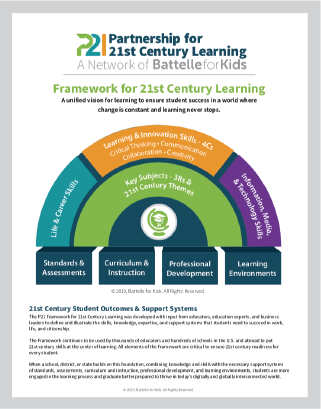
What is the Framework for Learning in the 21st Century? The Partnership’s framework for learning in the 21st century is based on the essential skills that our children need to succeed as citizens and workers in the 21st century. The Partnership has identified six key elements of a 21st century education, which are described below. An overview of the framework and the Partnership can be downloaded here. 1. Core Subjects. The No Child Left Behind Act of 2001, which reauthorizes the Elementary and Secondary Education Act of 1965, identifies the core subjects as English, reading or language arts; mathematics; science; foreign languages; civics; government; economics; arts; history; and geography. 2. 21st Century Content. Several significant, emerging content areas are critical to success in communities and workplaces. These content areas typically are not emphasized in schools today:
3. Learning and Thinking Skills. As much as students need to learn academic content, they also need to know how to keep learning — and make effective and innovative use of what they know — throughout their lives. Learning and Thinking Skills are comprised of:
4. ICT Literacy. Information and communications technology (ICT) literacy is the ability to use technology to develop 21st century content knowledge and skills, in support of 21st century teaching and learning 5. Life Skills. Good teachers have always incorporated life skills into their pedagogy. The challenge today is to incorporate these essential skills into schools deliberately, strategically and broadly. Life skills include:
6. 21st Century Assessments. Authentic 21st century assessments are the essential foundation of a 21st century education. Assessments must measure all five results that matter — core subjects; 21st century content; learning skills; ICT literacy; and life skills. To be effective, sustainable and affordable, assessments must use modern technologies to increase efficiency and timeliness. Standardized tests alone can measure only a few of the important skills and knowledge students should learn. A balance of assessments, including high-quality standardized testing along with effective classroom assessments, offers students a powerful way to master the content and skills central to success. back to topWhat is your mission? Serve as a catalyst to position 21st century skills at the center of US K-12 education by building collaborative partnerships among education, business, community and government leaders back to topWhy do students need 21st century skills? Every child in American needs 21st century knowledge and skills to succeed as effective citizens, workers and leaders in the 21st century. There is a profound gap between the knowledge and skills most students learn in school and the knowledge and skills they need in typical 21st century communities and workplaces. To successfully face rigorous higher education coursework, career challenges and a globally competitive workforce, U.S. schools must align classroom environments with real world environments by infusing 21st century skills into their teaching and learning. back to topWhat are 21st century skills? Read more about the P21 framework here. Are 21st Century Skills a key to a strong economy for the US? Yes, most definitely. Twenty first century skills are key to improving our nation’s competitiveness a knowledge driven economy. Twenty first century skills are the lifeblood of a productive workforce in today's global, knowledge-based economy. As more of our economic competitors move to foster 21st century skills development within their educational systems, the United States faces a critical challenge to keep pace in preparing our students to meet the demands of global community and tomorrow’s workforce. How can we address this global challenge? This cannot be accomplished without establishing stronger partnerships between educators, administrators, policy makers and the business community who must work collectively to better prepare our students for the realities of the 21st century. back to topHow does the Partnership work inform other education efforts? The Partnership’s work on 21st century skills helps inform other major education conversations.
Is the Partnership’s model making a difference? The Partnership’s model for 21st century learning has gained dramatic support and momentum. The Partnership is currently working with North Carolina Governor Mike Easley and West Virginia Governor Joe Manchin on major, statewide 21st century skills initiatives. The Council for Chief State School Officers (CCSSO) has chosen 21st century skills as a major leadership topic. The U.S. Conference of Mayors passed a policy resolution supporting a framework for 21st century skills. The resolution supports and encourages the development and implementation of comprehensive standards and skills required for 21st century jobs through establishing new policies, practices and programs in cities to better prepare students and enhance their opportunities. Since its inception in 2002, the Partnership has more than tripled its membership, growing from eight founding organizations to 26 members representing America’s leading business, technology and education organizations. The Partnership’s work has been endorsed by the U.S. Department of Education. back to topWhat can I do to help? If you’re an educator or administrator -- Take Action – The Partnership encourages educators and administrators to advocate for the infusion of 21st century skills into education by:
If you’re a Policymaker you can Create Visionary Education Policies – We urge policymakers to promote and create policies conducive to the integration of 21st century skills into education by:
If you’re a business leader or community leader we believe that Public-Private Partnerships Equal Success We urge business leaders to partner with local school districts to help create an education system that better prepares today’s students for tomorrow’s workplace by
What tools and resources have you developed to help advance your mission? We have a number of tools and resources available for viewing on our website. Please see our Resources page for more detailed information. back to top |